
Deep Dive: How linkerd-destination works in the Linkerd Service Mesh


This blog post was originally published on Bezaleel Silva’s Medium blog.
Recently, in our daily operations, we took a deep dive into the inner workings of linkerd-destination, one of the most critical components of the Linkerd control plane.
The motivation was simple: as our cluster grew and traffic increased, the question shifted from “Does Linkerd work?” to “How exactly does it react when everything changes at once?”. Frequent deployments, production scaling, security policies being applied — and at the center of all this, the destination service.
Throughout this analysis, I connected code reviews, observed behavior in production, and documented references. To organize this process, I used the Zettelkasten method, stitching together atomic ideas until a clear vision of the intelligence behind the mesh was formed. This article is the result of that synthesis. Shall we dive in?
Where the Magic Happens: The Role of linkerd-destination
Modern microservices architecture requires a dedicated infrastructure layer to manage communication: the Service Mesh. Linkerd, a pioneer in this space, stands out for its operational simplicity and high performance.
To understand how Linkerd works in practice, it is essential to dissect its Control Plane, specifically the linkerd-destination component. It acts as the central routing and policy authority for the entire mesh. It is responsible for translating the dynamic state of Kubernetes into actionable decisions propagated, in real-time, to thousands of proxies. Its three core functions are:
- Service Discovery: Translates logical DNS names into sets of actual endpoints, enriching each address with metadata (mTLS identity, locality/zone, and protocol).
- Policy Distribution: Informs proxies which connections are authorized, based on modern resources like the Gateway API and policy CRDs (Server, AuthorizationPolicy).
- Service Profiles (L7 Configuration): Provides advanced Layer 7 rules, such as regex-based routes, retry budgets, and timeouts.
To visualize how this orchestration occurs between components, the diagram below illustrates the communication flow between the control plane and the proxies in the data plane:
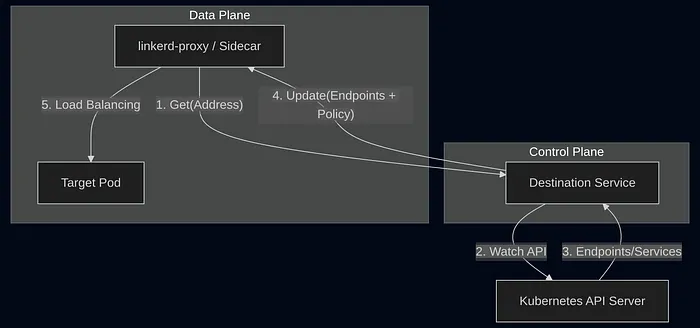
It is crucial to note the impact of a Degraded State: should the destination service fail, proxies will continue to operate using their last known configuration (caching). However, the cluster loses its ability to react to new deployments or immediate security policy changes, as the update channel illustrated above would be interrupted.
Internal Architecture: Separation of Concerns
To understand the behavior of linkerd-destination at scale, we must look inside the pod itself. Far from being a monolithic controller, Linkerd maintains a clear separation of concerns distributed across multiple cooperating containers.
The following diagram details how the Destination API is internally divided to simultaneously process discovery, profiles, and authorization policies:
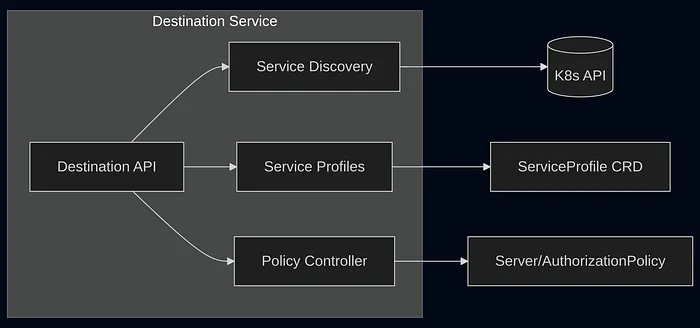
- Destination Container: The Heart (Go) Implemented in Go, it functions as
an event-driven controller. It utilizes the Informer/Reflector pattern from
the
client-golibrary, avoiding expensive polling against the Kubernetes API. - SP-Validator Container: The Guardian Acts as a Validating Admission Webhook, blocking syntax errors in Service Profiles before they reach etcd.
- Policy Container: The Judge Evaluates security policies (MeshTLSAuthentication) in a decoupled manner.
- The Proxy in the Proxy The destination pod itself has an injected linkerd-proxy. This ensures that control plane traffic is secured by mTLS and fully observable.
Performance Engineering: Events and Translation
The destination service does not periodically query the API; it reacts to Watches. When a Pod comes online, an event is triggered and processed by the EndpointTranslator.
This “brain” enriches raw Kubernetes data by cross-referencing IPs to extract identities and identifying availability zones to optimize routing. Furthermore, the use of EndpointSlices allows the system to process only “deltas” (partial changes), which is vital for the health of the system in large-scale clusters.
Destination API and gRPC Streaming
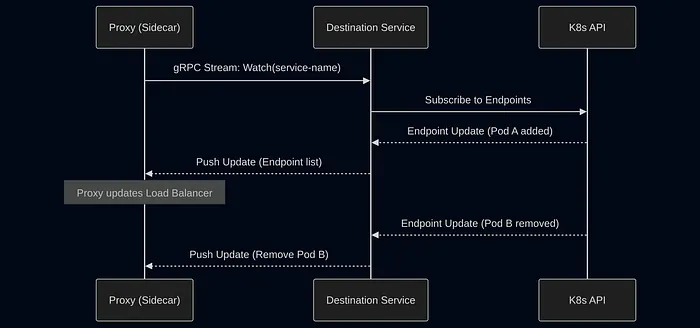
The interface between the proxy and the destination is a continuous flow. When
calling destination.Get(), the server keeps the stream open and sends:
- Initial Batch: The full state at the moment of connection.
- Incremental Updates: Only the deltas (add / remove).
- NoEndpoints: A critical message that triggers the proxy to execute fail fast if no healthy instances are available.
The sequence diagram below summarizes this lifecycle, demonstrating the efficiency of push-based communication:
Observability: What to monitor?
During our deep dive, we identified specific signals that act as the “EKG” of the control plane:
services_informer_lag_seconds: The delay between a change in K8s and Linkerd’s perception of it.endpoint_updates_queue_overflow: If greater than 0, it indicates the system is dropping updates due to saturation.grpc_server_handled_total: Check for an increase in error codes (anything other thanOK).proxy_inject_admission_responses_total: Reveals the success rate of sidecar injections across the cluster.control_response_total: Provides the real-time success rate of control plane responses.identity_cert_expiration_timestamp_seconds: The security countdown. Ignoring this metric means accepting the risk of total downtime due to expired mTLS certificates.
Note: You can obtain additional metrics using the command:
$ linkerd diagnostics controller-metrics
Conclusion
The linkerd-destination service is the junction point between the dynamism of Kubernetes and the predictability of a service mesh. Understanding its event-driven architecture and the role of the EndpointTranslator is essential for operating Linkerd with confidence in high-scale environments.
If you operate Linkerd in production or have ever needed to investigate control plane behavior under load, understanding the destination component completely changes the way you debug and scale the mesh.